A blue starfish. These were everywhere in Tonga.
YOLO in Niuatoputapu, Tonga Oct 2011
We planned for 2 nights to sail to Tonga from Samoa and we had to slow down and finally take in the genoa altogether to not arrive before sunrise. Winds were better than forecast for a change, but the depth changes in the ocean bottom out here near the Tonga Trench sent water pounding up under the boat and rocking us periodically as we crossed contour lines. The charts were a little off and the 1/2 moon had set about 11 pm. so I changed course to miss a small island off the north coast of our destination, Niuatoputapu. The two chartplotters had us missing the island, but a radar scan in the inky blackness showed us plowing into the end of it; not very reassuring in strange waters in the middle of the night, knowing the area is full of reefs! But we made it into the harbor/lagoon at first light and then had to figure out what date and time it was! We crossed the International Date Line and lost a day, but gained an hour. It's strange but these island nations are changing dates, time zones, and monies and we rarely hear about it.
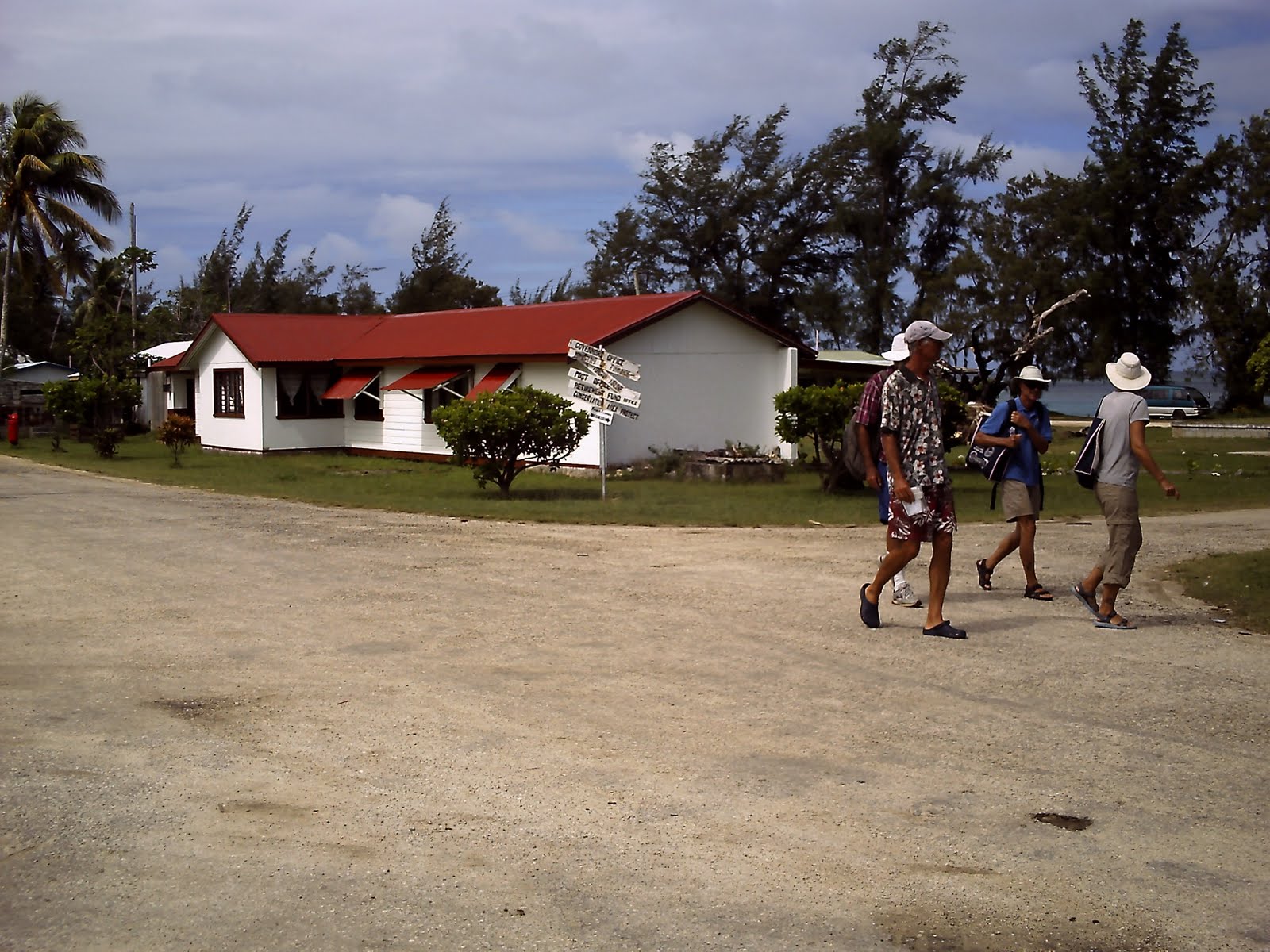
Niuatoputapu is a wonderful, roomy anchorage in good holding sand with a big concrete wharf and dinghy steps. A tsunami wiped out the village 2 years ago and the homes now are donated small rectangles from the Red Cross. Not very appealing and not very Tongan-like, but they have to suffice. No way to get more building materials here unless they buy them somewhere else and have them shipped in via the supply boat that comes once a month.
We were here when the supply boat arrived on Friday and the wharf was a beehive of activity til after dark. Fresh and frozen foods were unloaded along with passengers and bags and boxes of stuff from other parts of Tonga. Note: mail addresses here have no numbers--just the name and the village and the island will get stuff here!
Once the boat off loaded its cargo, it took on the local cargo to be sent to other parts of Tonga. Big blue wire bins were set on the wharf by the crane of the ship and it seemed each family had a bin to fill with their cargo. We saw pigs in crates built of sticks, bags and bags of mangoes and who knows what else! Names and the village + island were written on the bags in black magic marker.
While the ship's crane moved the cargo on and off the ship, and the village trucks brought people and cargo to/from the wharf, the local kids were having a ball climbing the mooring line from the wharf to the bow of the boat and jumping off the bow into the water. Nobody scolded them or told them they shouldn't be doing it; it seemed the best thing to do for the kids and I had to remind myself that we weren't in litigious America anymore. I counted 35-40 kids playing on/around the ship at the end of the wharf and nobody got hurt. Even I cringed when they dove off the bow into the water near the concrete ramp and jagged chunks of coral making up the breakwater for the wharf. The big black fender meant to keep the ship off the concrete had been a favorite water toy for days and remained along the side of the wharf as the boat never used it. Kids frolicked with the shouting and laughter lasting until after dark. The freighter left the next morning early so the kids had to find other sources of fun. Seems like they all come to the end of the wharf to swim and jump in the afternoons after school is out.
There are only 3 villages on the island. We walked to the bank in the 3rd and farthest village to exchange money to pay our fees for Customs, Immigration, and Quarantine. We skipped the Health office fees (the biggest one!) as they didn't come to the wharf and the local contact said they do nothing and charge too much and we weren't going to spread any disease; she encouraged us to write a letter to complain about the high charges from the Health office as she felt it may be keeping cruisers away. We never cleared in with the Health person, so we don't know how much they charged, but we believe it was more than all the others combined. The local currency is the pa'anga and one is worth about 61 cents US. There is nothing to buy on this island so the fees were the only required expense.
The day we arrived, the local contact person, Sia, had arranged a welcoming potluck at her house so I made chicken fritters with hot chile jam and we joined the cast of cruisers for a wonderful time. I had to write out the recipe for the chile jam numerous times as that was a major hit. Our hostess provided some local dishes and free fruit--bananas, papayas and mangoes. Friday was a pig roast for $25 pa'anga (about $15) for 2 piglets, cassava, taro, taro leaves with beef seasoning, curried sea snails, mangoes, and flour dumplings with a sweet coconut sauce. Quite tasty. By the way, 2 piglets fed over 20 people. The pigs and piglets are running all over the island and the little ones are sooooo cute! They won't let us get close enough to pick them up, but there are dozens that run and play and feed everywhere here.
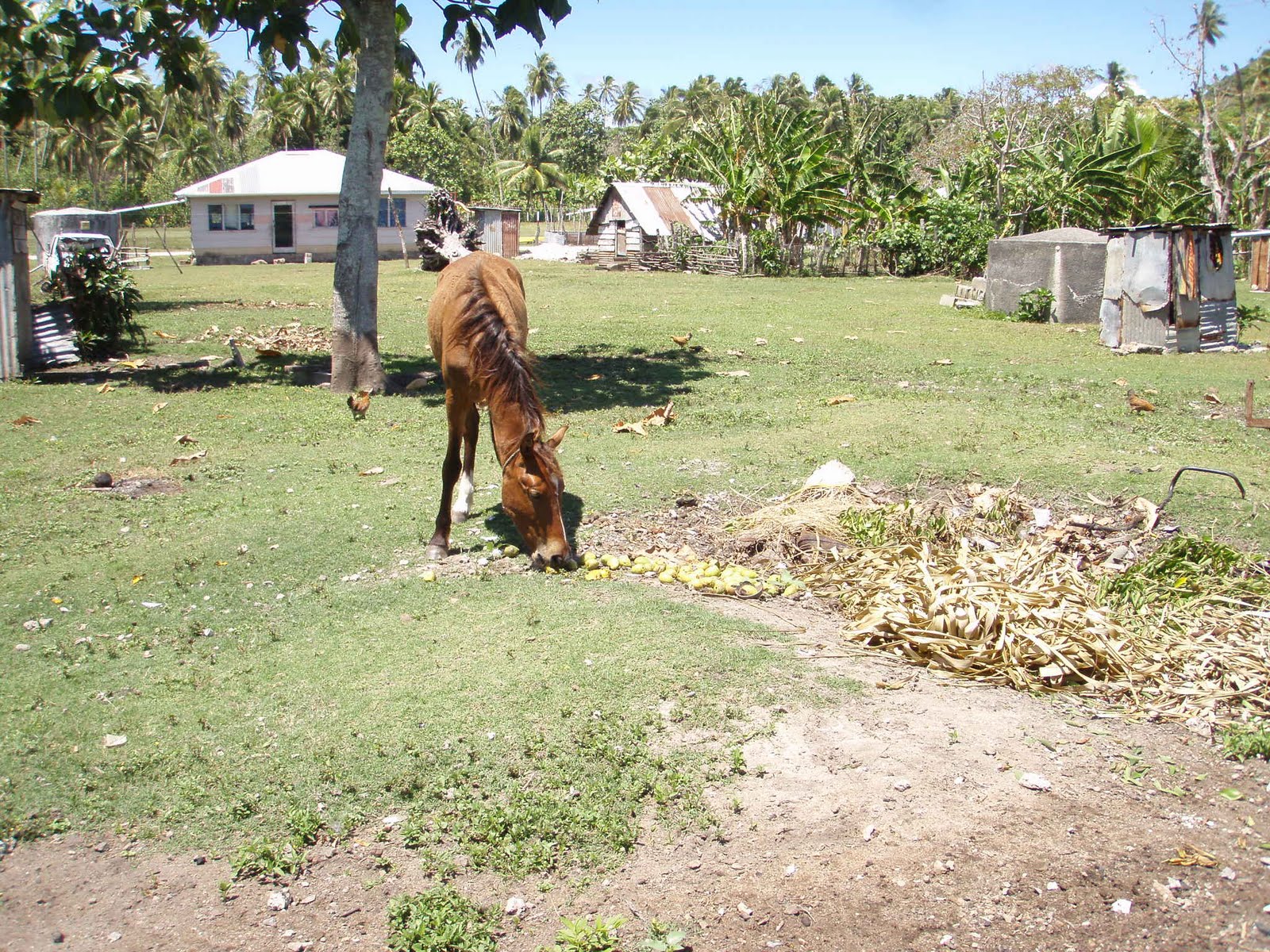
There are many horses on this island, too. Surprised me. And very few get ridden. Cruising guides talk about horse-drawn carts, but when I asked a local who picked us up hitching for a ride, he didn't even know the word 'cart'. Perhaps the tsunami washed them all away... we heard it broke every small wooden boat in the harbor, so many lost their way to go fishing. The island still hasn't fully recovered after 2 years. Vehicles were tumbled and thrown around and the guts of one without a body or chassis now acts as a kava crusher in someone's yard. They've rigged the engine and transmission to crush kava to be used in the ceremonial drinks. Kava bowls are 4-legged wooden bowls that the men drink the nasty concoction from; we haven't been to a ceremony yet.... Will let you know if Jason drinks the stuff.
I joined 2 other couples for a hike along the ridge that makes up the center of the island. We had to bushwhack our way through some jungly growth at times, and do some rock climbing to reach the higher points, but the views were stupendous! Three and a half sweaty hours later, we had to do some butt sliding down the steep slopes to get back down to the village. We picked up a few mangoes along the way and I jumped into the bay as soon as I got back to the boat. It is hot here!
Jason and I walked to the last village on the island, Hihifo, where we expected to find a fresh water spring to swim in. We found another couple enjoying the cool waters in their underwear and joined them in the refreshing dunk in clear cool water. Fish even liked it here and we spent enough time to bring down our body temps. It was a non-descript gully of coral with a tiny cave at one end. It fed into the river that went into the lagoon behind a reef. We may have missed it if we weren't expecting to find the other couple there, but it was a delightful highlight of Niuatoputapu! We all left with wet clothes to keep us cool on the walk back to the wharf.
Cruisers chipped in and provided Sia with a new battery to keep her VHF radio operating so she could be the contact for the cruising community. She let us know of the local events (her pig roast, church times and the free lunch from the underground oven (an umu) afterwards, etc.) and she was happy to give us fresh fruit from their local trees. Unfortunately, a disease had killed the lime trees on this island so we couldn't restock those here. But I still managed to make some awesome papaya and mango salsas with the cilantro I'd found in Apia. One never really knows what is going to be available and the cruising guide info is often outdated or is dealing with a different season than when we are here. I was surprised that the locals sent bagfulls of mangoes to their friends and families down in Nukualofa (6-700 miles south) as they don't get mangoes in season there.
The waters here inside the reef are pretty murky, but out near the reef and the little offshore islands, it is clearer, so we went snorkeling out on the motu. We saw segmented sea cucumbers that were about 3' long. They looked more like a snake but had the tentacles at one end like a sea cucumber. Other sea cucmbers were dark teal with stubby spikes or small and black like the ones the locals pound and eat. I saw big royal blue starfish here, too. They roam the coral rubble in the shallows left from the earthquake and tsunami. I found some cool pointy shells that looked like miniature Madonna tits but Jason threw them overboard before I could even get them back to the boat. It's not often I find matching pairs of shells like them but I am getting more selective on what I'll keep, as New Zealand has a reputation of taking many things away from cruisers.
We're off to the Vava'u group of islands in Tonga, another overnight sail, so will send an update from there separately. We'll spend a couple of months in the archipelago of Tonga and then jump off for NZ in early Dec. Some folks are already making the crossing there so we are trailing the pack of Puddle Jumpers now. We may come back here next year! Stay sane and healthy y'all!
 The wreck on Nomuka Iki. Good shells here.
 Tofanga sunset.


 Local boys who swam out from O'ua. The middle one, Freddie, is dragging a huge bundle of pandanus leaves with him. They use the leaves for weaving all sorts of things after the salt water has softened and bleached them out. Why he swam the 1/2 mile out to YOLO trailing them behind him is beyond me. He didn't speak English. Just climbed aboard the boat and stood there wiggling his eyebrows til he jumped back off and swam away.
 The bunch of bananas the boys on O'ua brought us. We gave them a couple of t-shirts. Of course, these green bananas all ripened at the same time so we had banana bread, banana muffins, banana pancakes......
 Local boys who swam out from O'ua. The middle one, Freddie, is dragging a huge bundle of pandanus leaves with him. They use the leaves for weaving all sorts of things after the salt water has softened and bleached them out. Why he swam the 1/2 mile out to YOLO trailing them behind him is beyond me. He didn't speak English. Just climbed aboard the boat and stood there wiggling his eyebrows til he jumped back off and swam away.
 The bunch of bananas the boys on O'ua brought us. We gave them a couple of t-shirts. Of course, these green bananas all ripened at the same time so we had banana bread, banana muffins, banana pancakes......