Friday, November 9, 2012

Komo in Lau in Fiji

When we finally tore ourselves away from friendly Susui, we headed to the island of Komo, an overnight sail to the SW.  We were the only yacht here for the 10 days we stayed.  It was quite a hike to the village--up and over the hill and down a red dirt path past the school and into the village. 

Matui met us the first day we anchored and he was our guide whenever we went to the village.  Guides are usually related to the Chief and Matui was the grandson or nephew, I'm not sure.  Family has lots of blurred lines and crossed meanings here.

Note: the pics below aren't necessarily in order of their happening.

Jason and Karen with the island nurse in front of the medical clinic at Komo.  The crimps in the fishing line gouged Karen's hand when bringing in the mahi mahi below and the nurse changed the bandage since it had gotten wet with ocean water coming ashore that day.
 The mahi mahi we caught en route to Komo.

Some of Karen's cowries found on Komo.

School kids doing a traditional dance for us in their classroom.
 Schoolkids outside to do another song and dance for us.  They sang their national anthem for us the last day we were there as a good-bye, too.
 The view of the lagoon in front of the village.  This is the view from the top of the hill we had to walk over to get from our anchorage to the village of Komo.
 A beautiful Komo sunset
 The mahi mahi landed on YOLO.  They are such a colorful fish at first, but the color drains away quickly after they are brought aboard (as you can see in the pic above).  This female was good eating.

The village water supply is in this structure, in open vats with this as the only protection to keep the water clean and free of falling debris.
 Our first visit to the village, Matui (on left) brought us into his home and fet us papaya, banana, lemon leaf tea and donuts they called pancakes.  So sweet and friendly and generous in their hospitality.
 Matui with a giant clam shell on the rocky part of the shore.  These gian clams are considered endangered but we saw lots of them alive and very colorful, though few as big as these in our snorkeling depths.  There were lots of these shells everywhere, but we're not allowed to have them as they are on the list of endangered species.
 An old sewing machine now used as an anchor in a local boat.
 Matui's mother, Sarah, rolling herself a cigarette with the local tobacco called suki.  Who needs rolling papers?  Just use an old newspaper or a page of an unread book.  I had a really poorly written book I'd read and was thinking of giving her to use the pages for her smokes, but thought that might send the wrong message.  Magazines were a much more popular choice than books here.
 Sarah and her cigarette.  Not her most flattering pose, eh?

A Komo woman weaving a mat in her home.  Mats are considered very valuable and show prestige.  They are kept as heirlooms and given as expensive gifts.
 The yam, cassava and papaya Matui gave us on our last day as a farewell gift.  These baskets of woven palm fronds are everywhere.
 YOLO at anchor off Komo.  Looking back from the hilltop on the way to the village.
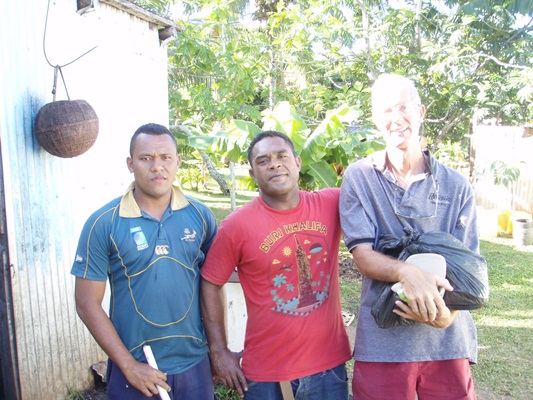
 Jason, Matui, and Jason. The insisted they walk us back over the hill and carry the haul of fruits and veges for us as we prepared to leave.
 The drying coconut twine on the roof of the homes.  It is called mangi mangi and is the principle source of income for these folks.  They braid the coconut husk strands into this rope and sell it for approximately $5 for 75 feet.  I don't know how they survive....
 China has recently begun buying dried sea cucumbers from Fijian islands and many of the islanders are pillaging the sea floor to gather them to sell.  They dry them, salt them, and send them to a big city to be sent to China.  They get a pittance for them and I'm afraid they'll decimate the seas around them for a quick buck for a Chinese aphrodisiac.
 
 Palm fronds drying to be used for weaving
 Jason with coconut husk fibers like the ones used to braid into mangi mangi rope.

Vanua Balavu and Susui in northern Lau Group

We made it through the pass to Vanua Balavu and the Bay of Islands just as a rainshower dumped on us, obscuring our vision as we came through the winding, coral-sided pass.  Of course, this is just when our chartplotter also decided to stop working.  We definitely had Murphy aboard as we arrived in these outer islands!
 
The "church bells" (drums) at Susui.  They are carved from breadfruit tree trunks, as are the dugout canoes and catamarans that we see throughtout these islands.

Our guides Jacob and Soku.  Soku could climb any tree around and got us lots of coconuts and papayas as well as some land crabs. 

Jason in our new aluminum dink he designed and had made in NZ.

The land crabs the chief's son, Save, and Soku caught and cooked for us on our beach walk.  They are more trouble to eat than they are worth, but it was fun to try.

Karen with her perfect chambered nautilus shell she found on the beach walk.  Another complete shell was a little dirty and I gave it to Save to clean and perhaps sell.  These shells are amazingly beautiful!  And it's pretty unusual for one to show up in the shallows in such perfect condition.

Jason and Jacob in Somosomo, the big village on the main island of Vanua Balavu.

Jason swinging on a rope swing made from some ship's old mooring line.
 Save and Jason on the beach at Susui.  Save is the chief's son.
 The Chief of Susui with our gift of kava root tied in a bundle.  It is proper protocol for visitors to present the local chief a gift of kava as "sevusevu", a show of respect and request for permission to be in their lands and waters.  If accepted by the chief when presented by the local representative on our behalf, then we are welcomed into the village and have free roam of the village and use of the beach and lagoons and such.  Each village has their own chief, so we bought 5 bundles of kava before we left Savu Savu.  This was our first time to do sevusevu.  The chief didn't speak English and  barely had a tooth left in his mouth.
Beach in Bay of Islands

Limestone outcrops in Bay of Islands.  These remind me of pictures of Palau.

Clifftop view of some of the Bay of Islands

another view from the clifftop.

Looking down from clifftop.  We anchored just at the left edge here the next night.YOLO at anchor at mushroom rock.

Looking back up at the cliff that provided the previous views from our anchorage.

Another mushroom island in BOI

Karen in her bush hat at clifftop with Bay Of Islands view in background.

YOLO on the right from the plateau at the top of the island of Vanua Balavu in the Bay of Islands.
 We had to climb over 200 stairs like these to get to the plateau.  At the top was a plateau with coconut groves and cattle and sheep and a few buildings.  One side was the anchorage above and the other side was the Bay of Islands.  nice views.
 On one of the buildings at the top of the plateau.  They gather coconuts and press them to get coconut oil to sell.
 
 Tiny finger bananas that are soooo sweet!  Ladyfingers are usually just a bit bigger and these are so cute.

YOLO at anchor in the Bay of Islands by a mushroom island.
The locals catch the fish and string them and take them to the nearest town,Somosomo, to sell.  They fish all day and come back in late afternoon in the village boat, then have to navigate the reef-strewn lagoon in the dark to get to town and back to sell their fish so they can buy other foodstuffs.  Quite a feat of naviagation in these waters, believe me! 

Schoolboys ringing the bell (beating the drum) for recess to end.
 Several yachts took in pictures of their homelands to share with the schoolkids in Susui.  We had Swiss, Canadian and Americans showing pictures on a laptop.  Most involved snow and ice as these kids have never seen it.

Beachfront in Lau Group.

Viani Bay and Qamea

We headed East from Savu Savu trying to make our way to the Lau Group of islands, where the villagers are still living a subsistence living off the land and sea.  They are still living in a more traditional way.  Tourism wasn't really allowed in these islands until just recently; they were trying to keep the tradional ways alive and intact. On the way we snorkeled Rainbow Reef and then headed into Naivivi Bay on Qamea where we ran aground on some coral rocks.  The local guys helped lift/push us off and we were there for several days enjoying the local hospitality.

Bill and the tapa cloth gifts he gave us before we departed Qamea from the village of Vatusongosongo.

Karen enjoying some of the sugar cane Bill brought out as a welcome gift.

The school boat vs a school bus.  No roads here, so the kids get picked up and dropped off by boat every day.

The "Wishing Stone" at Vatusongosong.  Legend says men used to write their wishes on leaves and tuck them into holes in this rock so they would come true.

Savu Savu May 2012

Red face carved in dirt in Fiji

Hot springs onshore at Savu Savu, Fiji

Dinner in Savu Savu with the 'outlaws'

Natabele shopping center.  Leaves a lot to be desired compared to a mall in the US, eh?

We had to share the anchorage and moorings at Waitui with the seaplane, too.