Thursday, March 28, 2013

YOLO in Noumea, New Caledonia Nov 2012


Noumea, New Caledonia was great for baguettes of French bread and Brie cheese, but the scenery left much to be desired.  New Caledonia has been mined for decades and the soil is so full of minerals that it will hardly support plant life.  Once cleared, the land stays pretty barren for a long time.  The main harbor at Port Moselle still has a mineral plant right at the water that spews different colored smoke, depending on what they are crushing and processing that day.  Nickel is one of the main minerals mined here and the greenish leftover crushed rock is evident.  The nickel dust is dangerous to the lungs and the plant is not allowed to process when the wind blows the dust towards the city of Noumea.
The locals still get out and paddle and sail.

Local yachts raced in the harbor all around us.

We rented a brand new van (only 35 km on it so far) with a couple of other cruiser couples and hiked around in the Blue River Park area for a day. We got stuck in the gooey red clay and the wheels were just coated in the slippery stuff.  We almost slid the van off into the creek.  No wonder the rental company told the driver he wasn't allowed to take the vehicle here....  With 5 of us pushing sideways so the van didn't slip over the edge into the gully, we got it back up on fairly flat ground and turned around.  The driver then gunned it and slip-slided his way back across the new bridge (no rails yet) and onto fairly firm ground. 
Blue River Park waters
Jason in the creek after slipping and getting wet.
 
Drowned forest in the park.

Karen in a hole on the side of the road.

View from hike in Blue River Park.

Dirt chasms on the hillside

The old bridge structure at creek.  You can see the log ends facing you in the clay.

The slippery goo we got stuck in.

We went back to a hiking and picnic spot and had lunch and then hiked around a few trails and up a few hills to some scenic outlooks.  We looked out over the Drowned Forest--a bunch of dead trees standing in water.  Whoohooo, this is exciting!  I did see some cool pitcher plants on one walk uphill; I had never seen them in the wild before.  We got lost in town on the way back and ended up on a street that ended in a ramp into a bay of water.  The street was barely wide enought to turn around in.  It was just temporary, though, and we made it back to Noumea and our boats after a long, tiring day.
A cool fern that felt like plastic.

Pitcher plants on the hike


The other couples were staying in the marina, so they got the tasks of cleaning all the red clay and dirt off the inside and outside of the van so we didn't get in trouble and get charged for a cleaning fee.  Glad we missed that chore!  Those couples left a few days later for Australia and we headed back towards the southeast to the Isle of Pines to see some of the pretty island scenery of New Caledonia.

We passed some reportedly great islands on the way in here, but we're not allowed to stop anywhere until we clear into the country.  And then it's too hard to head back to go see those islands unless you want to head into wind and waves or go all the way around the island and come past them again.  We didn't have the time or inclination to do either.  I think the island takes on a whole different character once you leave Noumea and there are lots of places to enjoy along the coasts, but you really need a lot of time to spend to get to them all.  We just couldn't do it all justice, so had to just pick a spot to explore.

We took 2 days to sail back towards the channel and stopped at a couple of scenic spots on the way just for the nights.  We didn't dare go swimming in the greenish water as we were told the bull sharks like the murky waters and you can't see them coming.  Our first night was by a rockface that had a tiny trickle of water plummeting over the edge to make loud dripping noises from afar.  I had to get the binoculars out to find the source of the sound as the water slid down a flat face of a rock until it fell off the edge.  My camera couldn't even show the water.

This is a barge of recycled metal we passed as we headed to the Isle of Pines.
 A view of the chart marking the entrance to Isle of Pines through the reefs.

Our first night's anchorage spot as we sailed to Isle of Pines from Noumea.

I took this pic from an online cruising guide to New Caledonia.  It shows the red dirt and an anchorage that we didn't stop in, but I thought the picture was good and the upper right hand corner of the shot shows where it is on the island, so we weren't far from this one.

Clouds as we motored through Woodin Canal in the morning.

Another anchorage.  The rockface is where the invisible waterfall was.
We reached Kuto Bay on the Isle of Pines in the afternoon after a long sail through the reefy area.  There is a clear path that is marked on the charts and the big ferries use it to avoid the coral.  Jason pushes the envelope and we cut a few corners and sailed along the outer edge to reach the bay, but there was always enough water.  There was only one other catamaran in the bay when we anchored.  The mile-long beach of white, talcum-soft sand became Jason's favorite beach to walk on.  It really is a pretty place.

Beach at Kuto Bay.  Pure postcard paradise.


Tuesday, January 1, 2013

YOLO on Ambrym

Ambrym is known as the "black magic island".  It has 2 active volcanos that spew smoke and ash continually.  You can get to them by hiking for a full day up a tough jungle path.  Nothing easy like the volcano on Tanna.  We didn't want to visit these volcanos and Jason didn't have any footwear except worn Crocs to walk in anyway.  We bypassed the first couple of anchorages at the west and northwest end of this island as we approached it, figuring we still had enough daylight to motor around further and get more out of the smoke and ash plumes.  We were right for a change.  We got to the anchorage and realized it was just beyond the edge of the smoke cloud.  Normally, the anchorages we bypassed were the ones with the cleaner air, but the winds had shifted and we could breathe better here, just beyond the edge of the haze.
 
 Ambrym peak.

Bouma Point anchorage.  A black sand beach.  You can see the cave near the center.

The cave entrance with black sand beach

The edge of the volcanic haze over Ambrym.
The volcanic haze as it usually appears near Ranon.  We missed most of this as we timed our stay for luck this time.
 
There was a hot river at the edge of the black sand that was fed by the volcano-heated waters further inland.  It was too hot to stay in at some places, but we found some spots that were like hot tubs and did our laundry and relaxed in the hot waters. 
Karen in the hot river.

Karen relaxing in the hot river on Ambrym at Baouma Point.

A dog on the edge of the black sand at mouth of hot river.

Linda on steep black sand beach at Baouma Point.

Emma and Karen in the cave at Baouma Pt.  Emma was from a nearby village and had spent the night on the beach with some tourists.  The tourists were taken back to their accommodation by a boat and Emma remained.

Emma showing us how the matted material on the cave floor could be folded over and used as a blanket.

Emma digging a crab out of the sand.  Note the bits of plant debris in her hair.  She was dirty and smudged, but had such a welcome smile and was very friendly and knowledgeable.  She told us how she uses her slingshot (called a "lastic") to kill birds and how she finds wild bird eggs to eat.  People leave their leftover food in the cave for the next person to use.
Emma with the crab she dug out.
 A nudibranch in a tide pool at the end of the beach.  You are looking through the water at it.  Emma cautioned me against touching it as they may be harmful.

This blob was edible and a treat for Emma.  She carried it home to eat later along with a second one we found in the tide pools.
A shot through the water at another flatworm in the tide pools.

The edible blob in hand; I think Emma referred to it as a "pipla".

Fellow cruisers encouraged us to stop at Ranon and pay the price to see a 'rom dance'.  It was expensive, but very different from anything we'd seen yet.  This is also where they dress in the 'nambas' we'd seen in photos and read about.  Nambas are penis sheaths woven from plants and worn by the men tucked into belts.  So very unusual and found only here.  We had to hike about 45 minutes straight up a dirt path to reach the village of Fanla where the men perform the rom dance for tourists.  It is meant as a prayer for, or thanks for, a good yam harvest.  The view of our yachts below shows the beach blankets on the black sand in the village of Ranon as we began the uphill hike.

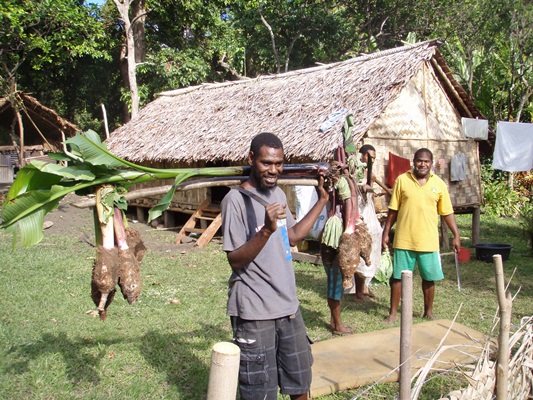
The men in Fanla village carting veges from their farms.  This one has taro plants balanced on a stick.
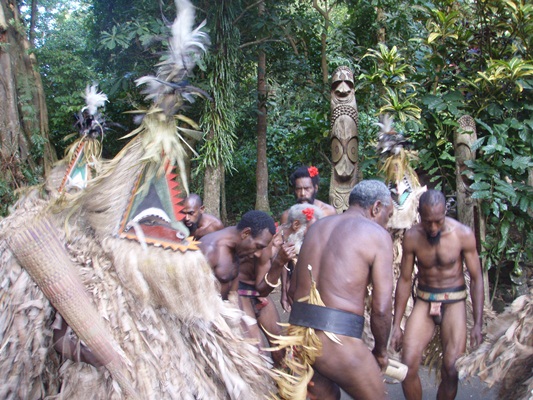
 These are pictures we took while the villagers did their rom dance for us.  We were allowed to walk around the ceremonial area while they were dancing but were not supposed to get closer than 1 meter to the men while they were performing.

This was an old lady on the path up to the village.  The hike up about killed me, and these villagers carry everything they buy and sell up and down this hill.  They must have healthy hearts.

Rom dancers in their costumes and nambas.

Chief Bong in the middle of the rom dancers.

Rom dance.  It really was just a bunch of stamping and stomping and chanting in their language.  They performed several 'songs' for us.

Rom dancers

Rom dance in Fanla.  Chief Bong danced with the aid of his walking stick.

Rom dancers.  The guys in the grass outfits kept the four corners of the group of dancers.  If we got too close, they shook those stick arms at us.
 Great costumes.  The one guy beat the handheld tam tam/drum to keep the beat.

Remember those masks we saw in that store in Pt Vila?  They were all from Ambrym, like these.

I thought it was cute that they covered their butt cracks with branches of leaves.  I imagine that has come about in the modern ages for modesty.

Rom dancers and Chief Bong

Stick arms warded off interlopers.  Linda wanted to buy one but couldn't figure out how to get it past Customs and into the USA.

The stick arms were adorned with "bells" made of hard nuts that rattled as they were shaken.
 Another tradition is the sand drawings.  A man squats or kneels in the sand and draws the drawing in one continuous motion, never lifting his finger off the sand.  This one represents the heart and lungs of a man.

Chief Bong in his namba in front of some tam tams.

Chief Bong from behind

Chief Bong playing the flute.

Chief Bong with the arm's length flute.  The other dancer in the photo is the one who carved the flute I bought.


Chief Bong with his curved boar's tusks necklace, just like the drum figure behind him.  They are a sign of great wealth and respect and only the highest persons in the village are allowed to wear them.
Bamboo flutes for sale.  I bought the one on top as a souvenir.

More flutes and carvings for sale after the rom dance.

Carvings and tam tam drums in the ceremonial area.   The rom dance is only allowed to be performed in the one place in the village.

Looking up at a palm tree whose fronds seemed to form a circle.  On the steep path up to Fanla to see the rom dance.

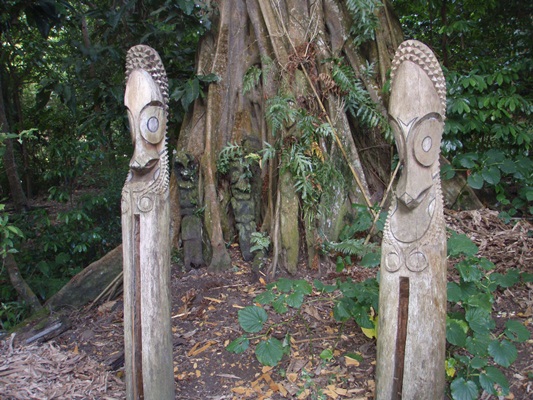
Fern tree carvings leaning up against a huge banyan tree just outside the ceremony area.

Fern tree carvings in Fanla.

The nakamal hut (community house) where the rom dance costumes are stored.  Tam tams surrounded the entire dance area.

The nakamal house is built out of fern tree logs, pretty unusual.  We weren't allowed to touch it or go inside.

The High Chief's house just beyond the ceremonial area.  We could look through the bushes at it but weren't allowed to go into that area.  It is still considered sacred and not a tourist site to be visited.

Karen in Fanla after the grueling 45-minute hike up the steep trail  I really, really appreciated the coconut drink once we got there.  I felt as whipped as I look!

Karen and Chief Bong after the rom dance.  He is in his namba, with his carved walking stick and curved boar's tusk necklace.  What a face, eh?

Linda testing the new tam tam being carved.  They already had the place picked out for this one to stand.  Note Linda's woven backpack she bought when I bought mine in Pt. Vila.

Karen and the rom dancers

The head of the new tam tam (drum) being carved in Fanla.

The new tam tam unveiled at our request.

The nut rattle at the end of the stick arm of one of the rom dancers.

Carved tam tam head in Fanla.

Tam tams in Fanla.

Tree ferns along the path