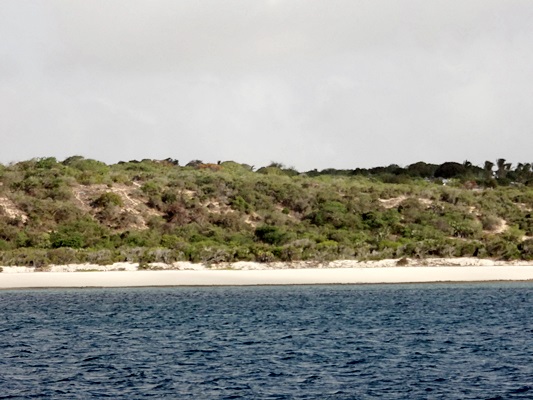
We made it to Richards Bay South Africa at about 2AM on a stormy night. We rode the fast current down from Mozambique but turned in too early and hit the countercurrent close to shore and had to fight the wind and current to get to the entrance to the bay. With both engines going, we could barely make 3 knots! It took us hours to cover the last few miles and a lightning storm swirled around to the south and east of us as we made slow progress.
When we contacted Port Control for permission to enter the harbor, we were told that we had to clear the channel within a few minutes as a big ship was coming in. Our fellow American, Sean, in the little yacht was just ahead of us and we relayed the info to him to get clear of the channel. He has no engine and his sail had just ripped an hour earlier in the storm we were watching. He pulled out of the channel and anchored next to us for the night. That's him below the morning after we arrived in South Africa.
The docks at Tuzi Gazi Marina in Richards Bay, South Africa. These docks buckle and go underwater when the wind blows too much. The docks aren't secured at the ends and I could stand on shore and watch the entire dock of boats move one way and then the other.
We backed into our slip and this was the view of the restaurants on the shore. The water got pretty shallow in front of us and we would've needed a high tide to get out.
Low tide and the water got pretty skinny. Our slip was just this side of that deep sea fishing boat you can see at the end of the dock. We moved to a concrete wharf at the international mooring area next to the marina. Free dockage, power and water!
We went with others to the Zululand Yacht Club on a Friday night as they are reputed to have huge T-bone steaks for cheap and they put on this Zulu dancers show.
YOLO tied to the concrete wharf at the international mooring side. Much more secure when the wind blew.
We took a tour to the iSimangaliso Wetlands to see hippos, crocs and birds. This elephant head was on the roof of the information bureau office.
And this plastic hippo was on the front porch of the Tourist Information office.
This safari vehicle picked us up in town and brought us to the pontoon boat we'd use for the wetlands tour.
Jason and the rest of our group heading to the Shaka Barge for our tour. Charles, the crew from
Saol Eile and his wife are the couple in front. They arranged the tour and we just tagged along for the day.
Cute animal prints on the seat cushions.
We left from the old dredger harbor and this is one of the old dredgers.
My first hippo sighting was right there in the water where we got on the boat. Talk about a wide load!
This little crocodile was sunning himself on an old water pipe in the harbor, too.
The golden weaver birds are a pretty bright yellow and they weave those round nests with their beaks. If the female doesn't like the nest, she'll rip it off and the male has to redo another one.
Hippos in the estuary waters. The river is blocked from the ocean these days so the water doesn't get flushed anymore. Hippos eat 60 kg of grass a day and what goes in must come out, so you can imagine the nutrients in that water!
White-faced whistler ducks parading on the sands of the low water in the wetlands.
A big croc just sitting on the sand with his jaw open. The animals all live in close proximity to each other but there isn't much action between them. Live and let live until one of them gets hungry.
The hippos formed big groups and slept in the shallow water. They tried to find a back to lay their head on to sleep, but they can just put their heads in the water and they raise up and breathe automatically without having to wake up.
This kingfisher is the largest in South Africa.
This Goliathe Heron was stretching his neck out while hunting for small fish.
This is what he usually looks like. He is the biggest heron in the country. If you look closely, you can see the little fish he caught in his beak.
The heron standing tall. They don't mind the boats getting close as they are used to them and they know the boats push the fish towards them.
A sleepy-eyed hippo front on.
The big groups of hippos are probably laying on their bellies in this shallow water. The babies are in the middle of the group and are protected.
Is that big guy winking at me?
One of them stands up and you can see how broad they are. Or maybe he just let off a fart. They are stinky when they do that!
The hide of this one shows some tooth marks. They can use their teeth/tusks to communicate and/or fight.
Jason on Shaka's Barge on our tour. The pontoons just nosed into the mud or weed or grasses to see what was on the shore.
Our guide, Anthony, was great and told us lots of stories and information about the animals and their habits. Here, he is showing us the tooth and tusks from a hippo.
These are hippo molars on a table. They are about as big as my fist.
Jason and Charles looking at the hippo tusks.
Karen with the hippo tusk and a group lounging in the waters beside the boat.
The tusks are hollow most of the way to the tip.
The whiskery mouth of a hippo in the water
This is a water buck. They have the toilet-seat-shaped white mark on their butts. They have very pretty striped antlers, too.
Lots of things to watch out for if you get in the ocean waters near the park.
I walked across the beach to the Indian Ocean at the shoreside and this is what I saw.
Never walk in a hippo trail at night as you could get run over by a hippo. And they can run faster than you can!
These tree roots were being sold as art along the road as we sped by. Very cool, I think. Would make a great coat rack, don't you think?
These wooden carved trays were hanging from the trees on the roadside as a way to display them for sale.
After a windy night, you can see how the dock buckled and sunk. The folks on the boats out there were stranded.
The dock and its power pedestal are under water. This was the corner nearest the walkway to the exit gate. Not going in or out just yet....
We learned early not to leave anything on the boat that could be moved. And no food left out, as these monkeys come by each morning. They are vervet monkies and the males have blue balls! They got into some boats that left their hatches open, so we closed up at night and when we left. Luckily, we have screens on all our openings so they couldn't get in anyway.
Talking across the sunken dock. With the power still going to the sunken power supply, nobody wanted to get in the water to fix it. The marina workers pumped the water out of the under-dock plastic floats repeatedly to try to refloat the dock. The design of the marina sucks and it can't handle big wind with lots of boats. Eight or nine months of the year, there are only a handful of yachts here, so the owner doesn't do anything to bolster the docks. The buckling happened several times while we were here, so we were very glad to be on the concrete wharf instead of in a slip.